September 12, 2026
How to Convert Website Leads Into Jobs: 2026 Guide
Learn how to convert website leads into jobs with faster response times, qualification tips, and follow-up scripts. Turn more inquiries into booked work.
Table of Contents
- Why Speed Is the Difference Between a Lead and a Job
- How to Qualify Construction Leads Before You Drive Out
- Contractor Lead Follow-Up Scripts That Get a Yes
- Best Lead Management Tools for Contractors Who Work in the Field
- Turning a Booked Job Into a Repeat Customer
- Common Mistakes That Kill Website Lead Conversion
- Frequently Asked Questions
Last Updated: September 12, 2026
Why Speed Is the Difference Between a Lead and a Job
Most contractors don't lose jobs because they lack skill. They lose them because they responded too late. Learning how to convert website leads into jobs starts with one uncomfortable truth: the first person to reply usually wins, and it rarely matters who's more qualified.
At DibsText, we built our entire service around that reality. A homeowner submits a form, and within minutes they're already texting two or three other contractors. The one who answers first gets the conversation, the estimate, and often the job.
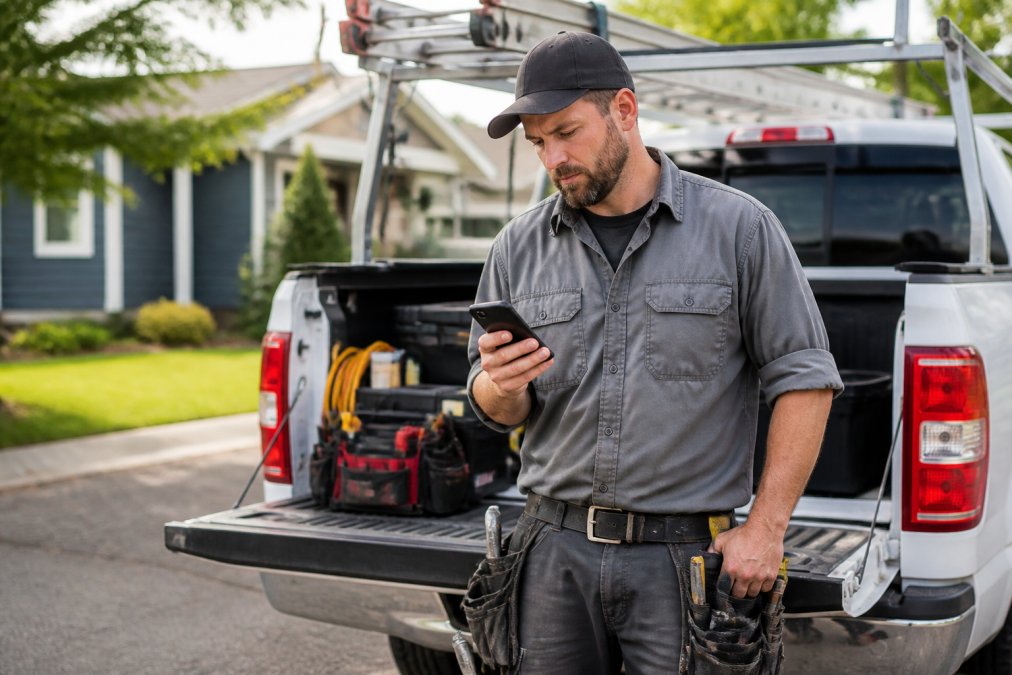
A contractor in work clothes standing beside a service truck, looking at a smartphone with a focused expression, tools visible in the truck bed behind him
The 5-Minute Rule in Practice
The five-minute rule is simple: contact every new lead within five minutes of submission, or accept that you're competing on price alone (hbr.org). Many contractors find that leads contacted quickly are far more likely to book than those reached hours later.
Here's what that looks like on a real job site:
- Your phone buzzes the moment a form is submitted
- You reply with a short text while walking to your truck
- You confirm a time to call back that same day
- You log the lead in your phone's notes app
No dashboard. No office. Just a fast reply from the field.
What Slow Response Actually Costs You
A common mistake is treating a website lead like a voicemail: something to handle tonight. By then, the homeowner has already booked someone else. The cost isn't just one lost job. It's the review they never left, the referral they never made, and the repeat work you never got.
Watch Out Waiting until the end of the day to respond to a new lead is the single fastest way to lose it. Homeowners typically contact multiple contractors at once, and the first reply usually ends the search.
How to Qualify Construction Leads Before You Drive Out
Qualifying a lead means confirming it's worth your time before you spend fuel and hours driving to a site. Lead qualification is the process of checking budget, timeline, scope, and location against what you actually want to take on. Most guides stop at "ask a few questions." A scoring model does the work for you, so you're not re-deciding the same judgment call on every lead.
A Simple Four-Factor Scoring Model
Score each new lead from 1 to 5 on four factors, then add the totals. This mirrors the data-driven lead scoring larger sales teams use, scaled down to a phone-sized workflow.
Factor
Score 1 (weak)
Score 3 (workable)
Score 5 (strong)
Budget signal
"Just wondering what it costs"
"We've set some money aside"
Names a range or has financing ready
Timeline
"Someday" / no date
"In the next month or two"
"This week" or a hard deadline
Scope clarity
One vague sentence
General idea, some details
Measurements, photos, or a written list
Service area
Outside your radius
Edge of your radius
Inside your normal route
How to read the total:
- 16-20: Drive-out lead. Call within five minutes and offer a same-day or next-day estimate.
- 10-15: Qualify by phone first. Ask two more questions before committing a slot.
- 4-9: Nurture lead. Add to a follow-up cadence and check back in two to four weeks.
A common pattern is that contractors who score leads this way stop burning Saturdays on tire-kickers and start protecting their best hours for jobs that close.
The Disqualification Questions Nobody Asks
Just as important as qualifying is knowing when to walk away. Ask these before you commit:
- Is the decision-maker on the thread? If you're texting a renter, a tenant, or a family member who isn't paying, the conversation stalls.
- Is the property inside your licensed and insured area? A great lead outside your coverage is a liability, not a job.
- Is the scope something you actually do? "While you're here, can you also..." is how a small job becomes a project you didn't bid.
- Has another contractor already started? Homeowners sometimes collect quotes after work has begun. Ask directly.
Turning a Low Score Into a Future Job
A 6 out of 20 today is not a no. It's a lead with a longer runway. Put it in a nurture sequence: a check-in text at two weeks, a seasonal reminder at three months, and a "still thinking about it?" note when the weather shifts. Lead nurturing workflows exist precisely because timing, not interest, is what usually changes.
Pro Tip Keep your scoring notes in the same place you keep the lead, a note in your phone, a text thread, or a lightweight tracker. If scoring lives in your head, it doesn't happen on a busy Tuesday.
Where Most Contractors Get Qualification Wrong
The mistake isn't asking too few questions. It's asking them in the wrong order. Lead with the two questions that can kill the lead fastest, service area and decision-maker, then move to budget and timeline. You'll save yourself a dozen dead-end conversations a month.
Contractor Lead Follow-Up Scripts That Get a Yes
The best contractor lead follow-up scripts are short, specific, and ask for one small commitment. Long pitches get ignored. A two-line text that names the next step gets answered.
Try these templates:
First reply (within minutes):
Hi [Name], this is [Your Name] with [Business]. Got your request about [project]. I can swing by [day] between [time] and [time]. Does that work?
Second touch (no reply after a day):
Hi [Name], just checking in on the [project]. Want me to hold [day] for an estimate, or is another time better?
Nurture (cold lead, two weeks later):
Hi [Name], still thinking about the [project]? I've got an opening next week if you'd like a quote.
Pro Tip Send the first reply as a text, not a call. Most homeowners won't answer an unknown number, but nearly everyone reads a text within minutes.
Best Lead Management Tools for Contractors Who Work in the Field
The right tool for most contractors isn't a full CRM. It's an instant notification system that pushes every new lead to your phone the second it arrives, so you can reply without opening a laptop. CRM software for tracking is genuinely useful once you have office staff and a pipeline of dozens of open estimates, but for a solo operator or a two-truck crew, a full CRM usually becomes a graveyard of half-entered records by week three.
The Real Trade-Off: Speed vs. Structure
Every lead tool sits somewhere on a spectrum between "fast to reply" and "easy to report on." You rarely get both without paying for it in setup time.
Option
Setup Effort
Works From the Field
Best For
Instant text/email alerts
Minutes
Yes, phone-first
Solo operators and small crews
Full CRM
Days to weeks
Partly, needs desk time
Larger firms with office staff
Email-only alerts
None
Poorly, easy to miss
Very low lead volume
Manual form checks
None
No
Not recommended
For field-based tradespeople, DibsText is built around the first row: real-time text and email alerts the moment a customer submits a website form, no CRM or dashboard required, setup in minutes, a free trial with no credit card, and automated A2P compliance handling built in. Speedy communication remains the most effective way to improve website conversion rates when potential clients are waiting for a professional response.
What to Look For in a Lead Alert System
Prioritize speed and simplicity over feature count. Four things matter more than any dashboard:
- Instant delivery. If the alert arrives in your inbox but not your pocket, it's not instant.
- Mobile-first notifications. A text beats a push notification beats an email, in that order.
- No login required to reply. If answering a lead means opening an app, signing in, and finding a record, you'll do it tomorrow.
- A visible paper trail. Even a simple text thread is a record. You want to be able to scroll back and see what was promised.
If setup takes more than an afternoon, it won't get used during a busy week.
The Human Side of Automation
This is the part most tool guides skip. Automation should buy you time to be more human, not less. A homeowner who gets an instant, obviously templated reply and then never hears a real voice will keep shopping. A homeowner who gets a fast text and then a two-minute call from a person who read their request will usually stop looking.
A few habits that keep automation from feeling robotic:
- Use their name and their project in the first line. "Hi Dana, got your note about the water heater" beats "Thank you for your inquiry."
- Reply as a person, not a brand. Sign with your first name. Homeowners hire people, not logos.
- Make one small ask. "Does Thursday at 9 work?" is easier to answer than "Let us know when you're available."
- Call after the first text. A short call after the initial reply is often what converts a lead into a booked estimate.
Watch Out Automating everything and never picking up the phone is a real risk. Homeowners hire people they trust, and a short call after the first text often seals the job.
Measuring Whether Your Tool Is Actually Working
Track two numbers for a month: median first-response time and reply rate on the first touch. If your response time is under five minutes and your reply rate is climbing, the tool is doing its job. If response time is fast but reply rate is flat, the problem isn't the software, it's the message.
FCC rules on automated text messaging and consent
Turning a Booked Job Into a Repeat Customer
Post-conversion retention is where most contractors leave money on the table. The job is done, you're paid, and the relationship quietly ends. That's a mistake.
A simple client onboarding habit changes it: send a thank-you text the day after completion, ask for a review while the work is fresh, and set a reminder to check in six months later. Those three touches cost nothing and often produce referrals and repeat work.
Key Takeaway The cheapest lead you'll ever get is the customer you already served. A short follow-up text after the job keeps you top of mind for the next one.
Common Mistakes That Kill Website Lead Conversion
Four mistakes show up again and again. Fixing them costs nothing.
- Slow first reply. The lead goes cold before you call.
- No clear call-to-action on the site. Visitors don't know what to do next.
- One follow-up attempt. Most jobs are won on the second or third touch (hubspot.com).
- No lead source attribution. You can't tell which pages bring real jobs, so you can't improve them.
Track where each lead came from, even with a simple note in your phone. Over a few months, patterns emerge. One page might bring steady work; another brings nothing but tire-kickers.
Watch Out Automating everything and never picking up the phone is a real risk. Homeowners hire people they trust, and a short call after the first text often seals the job.
Frequently Asked Questions
What is the 5-minute rule for responding to contractor leads?
The 5-minute rule says you should contact a new lead within five minutes of receiving it. After that window, the odds of reaching the person drop sharply because they are usually contacting several contractors at once. For field-based trades, this means your phone needs to alert you the moment a form is submitted, not when you next check email. Contractors who respond in minutes rather than hours consistently book more jobs from the same number of website leads.
What is a good lead conversion rate for home service businesses?
Conversion rates vary by trade, ticket size, and how well you qualify construction leads. A reasonable target for website inquiries that turn into booked jobs is roughly 20% to 35%, but the number matters less than the trend. Track how many form submissions you get, how many you actually reach by phone or text, and how many become paying customers. If your contact rate is low, the problem is usually response time, not your pricing or your pitch.
How can I follow up with website leads without being pushy?
Keep the first message short and specific. Confirm what they asked for, give a clear next step, and offer a time window instead of an open-ended question. A text like "Hi, this is Mike with [company]. You asked about a water heater replacement. I can stop by tomorrow between 9 and 11. Does that work?" gives the lead an easy yes or no. If they do not reply, one follow-up 24 hours later is enough. Two unanswered messages is the limit before you move on.
Do I need a full CRM to convert website leads into jobs?
No. Many solo contractors and two-person crews do fine without one. A CRM helps when you have multiple office staff, long sales cycles, or hundreds of leads per month. If you are in the field most of the day, an instant text and email alert system that pushes new leads to your phone may serve you better than a dashboard you never open. The tool matters less than whether you actually respond fast.
What should I do if I miss a lead notification?
Call or text back as soon as you notice, and acknowledge the delay briefly without over-apologizing. Something like "Sorry for the late reply, I was on a job site. Are you still looking for a quote?" works. Then check why you missed it. If your phone died, keep a charger in the truck. If the alert went to email only, switch to text alerts so the notification reaches you where you actually look.
How do I qualify a construction lead over text without wasting time?
Ask three questions in your first reply: what the job is, when they need it done, and whether they have a budget range in mind. For example, "What's the project, when do you need it started, and do you have a rough budget?" Most serious leads answer all three. If someone avoids the budget question twice, they are often price shopping. Qualifying early saves you from driving to estimates that were never going to close.
Winning work online comes down to being first and being human. DibsText sends instant text and email alerts the moment a lead submits your form, needs no CRM or dashboard, and sets up in minutes, so you can reply from the truck before the next contractor even checks their inbox. Start your free trial with DibsText and turn more website leads into booked jobs.
Stop losing leads to slow response times.
DibsText texts you the second a lead comes in. Free 14-day trial, no credit card.
Start Free Trial