September 1, 2026
Getting More Leads as a Solo Contractor: 2026 Guide
Getting more leads as a solo contractor starts here. Discover low-cost, high-efficiency strategies to fill your pipeline and win more jobs. Start free.

Table of Contents
- Why Getting More Leads as a Solo Contractor Is a Different Challenge
- Build Your Digital Presence Without a Marketing Team
- Best Lead Generation Tools for Contractors on a Tight Budget
- Contractor Lead Response Time: Why Speed Wins the Job
- How to Follow Up with Contractor Leads Without Losing Them
- Solo-Specific Time Management for Consistent Lead Generation
- Getting More Contractor Leads: What to Stop Doing
- Frequently Asked Questions
Last Updated: August 31, 2026
Why Getting More Leads as a Solo Contractor Is a Different Challenge
Getting more leads as a solo contractor is fundamentally different from running a marketing campaign for a larger shop. At DibsText, we work with independent tradespeople daily, and the core problem is constant: you're either on a job site or chasing the next one. There's no one back at the desk watching the inbox.
Solo lead generation isn't a scaled-down version of a big company's marketing funnel. It's a completely different discipline. The good news: solo operators have real advantages. You're faster to respond when you have the right systems. You can build a reputation in a specific neighborhood or trade niche that larger companies can't replicate. Those advantages compound over time, but only if you're consistently feeding your sales pipeline with qualified leads.
This guide focuses on what actually works when you're running a one-person operation: digital presence, lead generation tools, response strategy, follow-up, and time management habits that keep lead flow consistent. Lead volume is not the goal. Lead quality is. A solo contractor who books three good jobs a week from targeted outreach is in a far better position than one drowning in low-margin bids from high-volume pay-per-lead platforms.
Build Your Digital Presence Without a Marketing Team
Your digital presence is your storefront, and for most solo contractors, it's the first thing a potential customer sees before they call. Building a credible online presence doesn't require a marketing team or significant budget, it requires consistency and the right priorities.

A tradesperson sitting in their truck between jobs, reviewing their Google Business Profile on a smartphone, coffee cup on the dashboard, morning light coming through the windshield
Optimize Your Google Business Profile
A Google Business Profile is the single highest-ROI digital asset a solo contractor can have, and it costs nothing to set up. According to Google's guidance on Business Profiles for service businesses, a complete and accurate profile dramatically improves your visibility in local search results and on Google Maps.
The basics matter:
- Business category: Choose the most specific category that matches your trade. "Plumber" outperforms "Contractor" for local search ranking.
- Service area: Define your actual service radius. Overextending it dilutes your local search ranking.
- Photos: Add real job site photos, before/after shots, and finished work. Profiles with photos attract significantly more engagement.
- Reviews: Ask every satisfied customer for a Google review. Recent reviews signal activity and trustworthiness.
- Posts: Use the Google Business Profile post feature to share recent projects or seasonal offers. These appear directly in search results.
Responding to every review, positive or negative, signals professionalism and boosts your local search ranking.
Get a Professional Website That Converts
A professional website doesn't need to be elaborate. For a solo contractor, five pages and a clear call to action beat a flashy ten-page site that loads slowly and buries the phone number.
Your website's primary job is converting organic traffic into a contact form submission or phone call. Your service area, trade specialty, and contact information need to be visible without scrolling. Include a short contact form on every page: name, phone, project type, zip code. The more fields you add, the fewer submissions you get.
Local SEO Basics That Actually Move the Needle
Local SEO is how homeowners in your service area find you on Google. The fundamentals are straightforward: consistent business name, address, and phone number across all directories; keyword-optimized service pages; and inbound links from local sources.
According to Moz's Local Search Ranking Factors guide, proximity, relevance, and prominence are the three pillars of local search ranking. For solo contractors, prominence is largely driven by reviews and citations, both of which you can build without paid ads.
Focus your content on specific service pages rather than one generic "Services" page. A page titled "Drain Cleaning in [Your City]" ranks far better than a page listing every service in a single block.
Best Lead Generation Tools for Contractors on a Tight Budget
Most lead generation tools are built for companies with marketing budgets. Solo contractors need tools that are affordable, low-maintenance, and deliver projects worth bidding on.
Lead Source
Cost
Lead Quality
Time Investment
Google Business Profile
Free
High
Low (ongoing)
Referral Program
Free
Very High
Low (setup once)
Social Media (organic)
Free
Medium
Medium
Pay-Per-Lead Marketplaces
Variable
Medium-Low
Low-Medium
Local SEO / Website
Low-Medium
High
Medium (upfront)
Pay-Per-Lead Marketplaces: What to Know Before You Sign Up
Pay-per-lead platforms promise a ready-made pipeline, but lead quality varies significantly by platform, trade, and geography. Many platforms sell the same lead to multiple contractors simultaneously, so you're competing on speed and price the moment you receive it.
Before signing up, ask:
- How many contractors receive each lead simultaneously?
- What is the platform's lead return policy for bad contact information?
- Can you filter leads by project type, budget, or location?
- What is the average cost per lead in your trade category?
Contractors who get the best ROI respond within minutes, not hours. Speed is the differentiating factor. If you can't respond fast, these platforms will drain your budget without filling your schedule.
Watch Out Never commit to a pay-per-lead platform without testing it for 30 days with a capped budget. Read the cancellation terms before entering a payment method.
Social Media and Referral Programs as Free Lead Channels
Social media works differently for solo contractors. The goal isn't brand awareness at scale, it's building a visible local reputation that generates referrals and direct inquiries.
The highest-performing content is simple: photos of finished work, before/after videos, and behind-the-scenes clips. Authenticity outperforms polish. A genuine photo of a clean tile installation posted to a neighborhood Facebook group generates more local leads than a professionally produced ad.
Referral programs are the most underused lead channel for solo contractors. A structured referral program, even a simple thank-you gift card for every booked referral, dramatically increases the rate at which satisfied customers recommend you. According to Nielsen's research on consumer trust in recommendations, personal recommendations from friends and family remain the most trusted form of advertising.
Contractor Lead Response Time: Why Speed Wins the Job
Contractor lead response time is the single biggest variable in your conversion rate. The longer you wait to respond to a new inquiry, the lower your probability of booking the job.
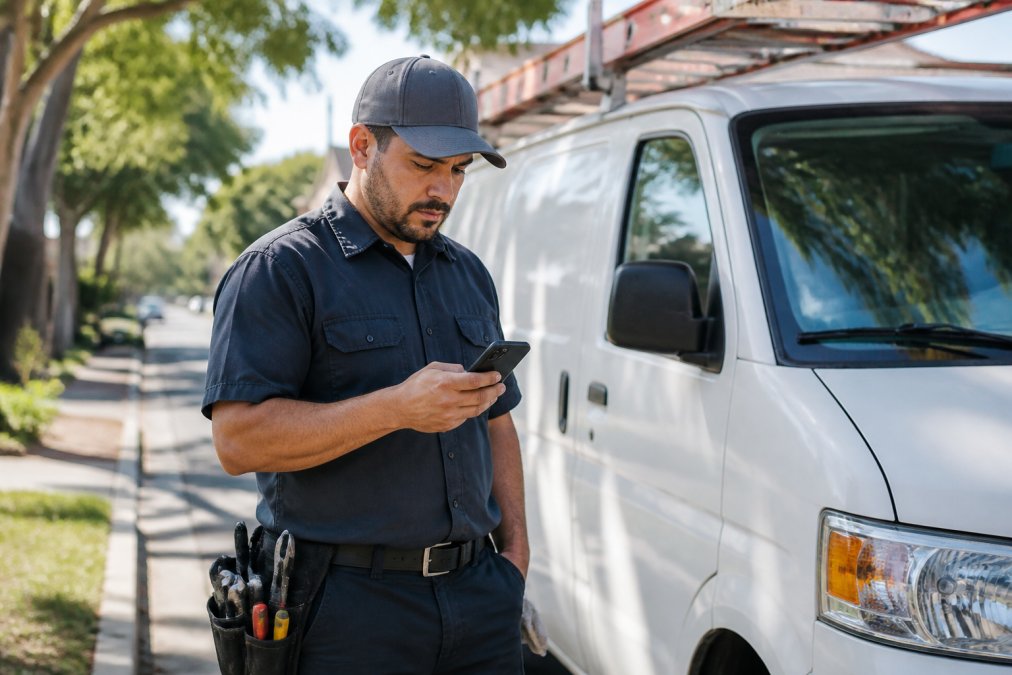
A solo contractor in work clothes checking a text message alert on his smartphone while standing next to a white work van on a residential street, midday sunlight, focused expression
Homeowners who submit a contact form often reach out to two or three contractors simultaneously. The first contractor to respond with a real, personalized reply wins a disproportionate share of those jobs. Not the cheapest. Not the most experienced. The fastest.
DibsText addresses this gap directly. The platform sends instant text and email alerts the moment a customer submits a website form, so you can respond while the lead is still warm, even when you're mid-job on a site. There's no CRM to log into, no dashboard to monitor. The alert comes to your phone, and you respond.
Key Takeaway Responding to a new lead within the first 5 minutes dramatically increases your chance of booking the job compared to responding hours later. For solo contractors without office staff, automated lead alerts are the only reliable way to achieve that response time consistently.
How to Follow Up with Contractor Leads Without Losing Them
The most common mistake solo contractors make is treating lead follow-up as a one-time event. You send a quote, hear nothing, and move on. That's leaving work on the table.
Qualifying Leads Before You Invest Time in a Quote
Not every lead deserves a full estimate. Lead qualification filters out low-probability or low-margin opportunities before you invest significant time. A quick five-minute phone call before you schedule a site visit answers key questions and saves hours of wasted quoting time.
A simple qualification framework:
- Timeline: Is the customer ready to start within 30-60 days?
- Budget: Do they have a realistic budget for the scope?
- Decision authority: Are you talking to the decision-maker?
- Location: Is the project within your profitable service area?
Post-Project Lead Nurturing to Generate Repeat Business
Post-project lead nurturing turns a one-time customer into a long-term source of repeat business and referrals. Most contractors do nothing after completion.
A simple post-project sequence:
- Day 1 after completion: Send a thank-you text or email.
- Day 7: Follow up with a request for a Google review with a direct link.
- Month 3: Send a seasonal maintenance reminder.
- Month 12: Annual check-in message.
This sequence takes almost no time, especially if batched. The return on investment from repeat customers and referrals far exceeds any paid lead source.
Solo-Specific Time Management for Consistent Lead Generation
The biggest lead generation failure for solo contractors isn't a bad strategy. It's inconsistency. When you're busy, marketing stops. When work dries up, you panic and do everything at once.
The fix is treating lead generation as a scheduled task, not a reactive one. Dedicate a fixed block of time each week, even 90 minutes, to lead generation activities: responding to reviews, posting a job photo, following up on quotes, or requesting referrals. Protect that block like you'd protect a paying job.
Automation is your best tool. Set up your Google Business Profile to prompt review requests automatically. Use a lead alert system like DibsText so you never miss an inbound inquiry while on site. Schedule social media posts in advance using free scheduling tools.
Contractors who maintain consistent lead flow through busy and slow periods share one habit: they never let marketing activity drop to zero, even when the schedule is full.
Pro Tip Block 30 minutes every Friday afternoon to review open leads, follow up on unanswered quotes, and request reviews from completed jobs. This single habit, done consistently, will do more for your lead pipeline than any paid advertising campaign.
Getting More Contractor Leads: What to Stop Doing
Getting more leads as a solo contractor isn't just about adding new tactics. It's also about cutting the ones that waste your time and budget.
Stop bidding on every lead. Low-margin, high-hassle projects drain your schedule. Qualifying leads before you quote protects your time for work that's actually worth doing.
Stop ignoring your existing customers. The easiest lead is a repeat customer or referral. If you're spending money on paid platforms while neglecting post-project follow-up, you're paying for leads you should generate for free.
Stop treating your website as set-and-forget. A website unchanged in two years signals inactivity. Add a new project photo or short blog post monthly. It takes 20 minutes and meaningfully improves local SEO.
Stop responding slowly. The contractor who responds first wins the job more often. If your current setup makes fast response difficult, that's the first system to fix.
Stop trying to be everywhere. A solo contractor who does one platform well outperforms one who half-maintains five. Pick Google Business Profile and one social channel and do those well first.
Common Mistake
Better Approach
Impact
Bidding every lead
Qualify first, then quote
Protects time, improves margins
Ignoring past customers
Post-project nurture sequence
High-ROI repeat and referral leads
Slow lead response
Instant alert system
Dramatically higher conversion rate
Inconsistent marketing
Fixed weekly lead gen block
Steady pipeline, fewer slow weeks
Spreading across all platforms
Master 1-2 channels first
Better results, less wasted effort
Solo contractors face a genuine structural challenge: you're generating leads and delivering work at the same time, with no support staff to bridge the gap. The contractors who solve this problem build simple, reliable systems that keep the pipeline moving even when heads-down on a job site. DibsText was built specifically for that gap: instant lead alerts delivered to your phone the moment a customer submits a form, with no CRM, no dashboard, and no complexity. Start your free trial with DibsText and start responding to leads before your competitors even see them.
Frequently Asked Questions
How do contractors get more leads without a big marketing budget?
The most cost-effective sources for contractor leads are a fully optimized Google Business Profile, a simple website with a clear contact form, and a referral program that rewards past clients. Pay-per-lead marketplaces can supplement these channels, but the highest-quality leads typically come from organic search and word-of-mouth referrals. Consistency matters more than budget: updating your profile weekly and asking every satisfied client for a review compounds over time.
How can I improve my contractor lead response time?
The single biggest lever is instant notification. Most customers contact multiple contractors at once, and the first to respond wins the conversation. Set up real-time text and email alerts the moment a form is submitted on your website. Tools like DibsText send these alerts directly to your phone so you can call back within minutes, even between job sites. Aim to respond within five minutes during business hours, response times beyond 30 minutes dramatically reduce your conversion rate.
Is lead generation worth it for a one-person contracting business in 2026?
Yes, especially when you focus on lead quality over volume. A solo contractor does not need hundreds of leads, a steady pipeline of five to ten qualified inquiries per week is enough to stay fully booked. The key is pairing low-cost lead generation strategies like local SEO and referrals with a fast follow-up system so no inquiry goes cold. Getting more leads as a solo contractor only pays off when you can actually respond to them before a competitor does.
How much do contractors typically pay for leads?
Costs vary widely by trade and platform. Pay-per-lead marketplaces charge per introduction, while SEO and referral programs cost time rather than money per lead. For current pricing on lead notification tools, visit the DibsText pricing page, a free trial is available so you can test the system before committing to a subscription.
This article was written using GrandRanker
For a deeper look at exactly how response speed affects your close rate, see Speed to Lead Wins More Home Service Jobs.
Stop losing leads to slow response times.
DibsText texts you the second a lead comes in. Free 14-day trial, no credit card.
Start Free Trial